July 28, 2026
AVIF vs JPG: Which Image Format Is Better? (Complete 2026 Guide)
AVIF vs JPG: Which Image Format Is Better?
Images play a crucial role in modern websites, digital marketing, e-commerce, and social media. The right image format can improve loading speed, enhance user experience, reduce bandwidth usage, and even contribute to better search engine performance.
For decades, JPG (JPEG) has been the most widely used image format for photographs because it offers good image quality with relatively small file sizes.
However, web technology has evolved, and newer image formats are designed to deliver even better performance.
One of the most promising next-generation formats is AVIF (AV1 Image File Format).
AVIF provides significantly better compression than JPG while maintaining excellent visual quality. This means websites can display high-quality images using much smaller file sizes, helping pages load faster and improving Core Web Vitals.
So, should you continue using JPG, or is it time to switch to AVIF?
The answer depends on your workflow, browser support requirements, editing tools, and the type of images you're publishing.
In this complete guide, we'll compare AVIF vs JPG based on image quality, file size, compression, website performance, SEO, browser compatibility, and practical use cases to help you choose the best format.
What Is AVIF?
AVIF (AV1 Image File Format) is a modern image format based on the AV1 video codec.
It was developed by the Alliance for Open Media (AOMedia) to provide superior image compression while maintaining outstanding visual quality.
Unlike traditional image formats, AVIF is built for today's internet, where faster websites and reduced bandwidth usage are more important than ever.
One of AVIF's biggest strengths is its ability to produce much smaller file sizes than older formats like JPG while preserving impressive detail.
Key Features of AVIF
- Next-generation image format
- Exceptional compression efficiency
- High image quality
- Supports lossless and lossy compression
- Supports transparency (alpha channel)
- Supports HDR (High Dynamic Range)
- Wide color gamut support
- 10-bit and 12-bit color depth
- Excellent for modern websites
Common Uses of AVIF
AVIF is increasingly used for:
- Website images
- Hero banners
- Product photos
- Blog featured images
- E-commerce stores
- News websites
- Portfolio galleries
- Mobile applications
- Progressive Web Apps (PWAs)
Because of its excellent compression, AVIF has become a preferred choice for developers focused on website speed and performance.
What Is JPG?
JPG, also known as JPEG (Joint Photographic Experts Group), is one of the oldest and most widely supported image formats.
Since its introduction in the early 1990s, JPG has become the standard format for digital photography because it offers a good balance between image quality and file size.
JPG uses lossy compression, meaning it removes some image data to reduce file size.
While this usually results in much smaller files than uncompressed formats, repeated editing and saving can gradually reduce image quality.
Key Features of JPG
- Widely supported
- Excellent for photographs
- Small file sizes
- Fast loading
- Easy to share
- Supported by virtually every image editor
- Ideal for digital cameras
- Great compatibility across devices
Common Uses of JPG
JPG is commonly used for:
- Photography
- Social media images
- Blog images
- Travel photos
- Product photography
- Email attachments
- Digital marketing
- Print-ready photos
Despite its age, JPG remains one of the most popular image formats because of its universal compatibility.
Modern vs Traditional Image Formats
Understanding the difference between modern and traditional image formats helps explain why AVIF is gaining popularity.
AVIF (Modern Format)
AVIF is built using advanced compression technology designed for today's internet.
It focuses on:
- Smaller file sizes
- Better image quality
- Faster loading
- HDR support
- Modern browser optimization
Because of these advantages, AVIF is well suited for websites where performance and user experience are top priorities.
JPG (Traditional Format)
JPG was created at a time when internet speeds and storage capacities were much more limited.
Although it remains reliable and widely supported, its compression technology is older and generally less efficient than AVIF.
JPG continues to be an excellent choice when maximum compatibility is required across older software, devices, and workflows.
Quick Comparison Table
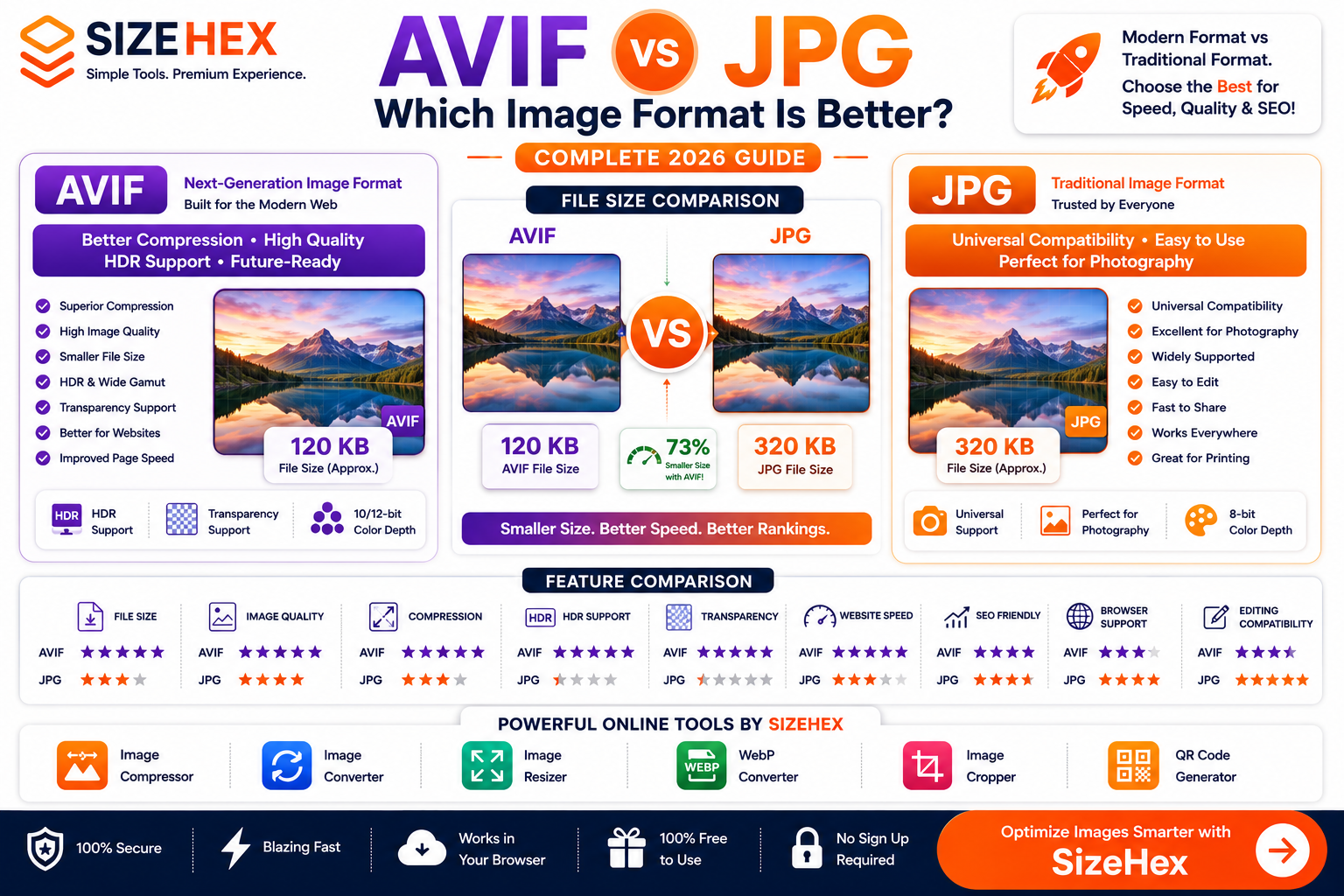
| Feature | AVIF | JPG |
|---|---|---|
| Image Type | Raster | Raster |
| Compression | Lossy & Lossless | Lossy |
| File Size | ⭐⭐⭐⭐⭐ | ⭐⭐⭐ |
| Image Quality | ⭐⭐⭐⭐⭐ | ⭐⭐⭐⭐ |
| Transparency | ✅ Yes | ❌ No |
| HDR Support | ✅ Yes | ❌ No |
| Color Depth | Up to 12-bit | 8-bit |
| Photography | Excellent | Excellent |
| Website Performance | Excellent | Good |
| SEO | Excellent | Good |
| Browser Support | Modern Browsers | Universal |
The biggest difference is that AVIF uses newer compression technology, allowing it to achieve much smaller file sizes while maintaining excellent image quality.
Image Quality Comparison
Image quality is one of the most important factors when choosing an image format.
Both AVIF and JPG can produce visually appealing images, but they differ significantly in how efficiently they store image data.
AVIF
AVIF delivers excellent image quality even at much lower file sizes.
Its advanced compression algorithms preserve fine details, smooth gradients, and subtle color transitions more effectively than traditional JPG compression.
AVIF is especially effective for:
- Product photography
- Landscape photography
- Hero banners
- High-resolution website images
- Mobile-friendly images
JPG
JPG has long been trusted for digital photography because it offers a practical balance between quality and file size.
However, because JPG uses older lossy compression, visible artifacts may appear at high compression levels, especially around sharp edges, text, or detailed patterns.
Repeated editing and saving can also reduce image quality over time.
Winner
🏆 AVIF
AVIF generally delivers better visual quality than JPG at similar or even smaller file sizes.
File Size Comparison
Smaller image files help websites load faster, improve user experience, and reduce bandwidth consumption.
Here's a typical comparison:
| Image Type | AVIF | JPG |
|---|---|---|
| Landscape Photo | 180 KB | 420 KB |
| Product Image | 95 KB | 240 KB |
| Blog Banner | 160 KB | 380 KB |
| Portrait Photo | 120 KB | 290 KB |
Actual file sizes vary depending on image content and compression settings, but AVIF often achieves noticeably smaller files than JPG while maintaining comparable visual quality.
Winner
🏆 AVIF
Compression Technology
Compression determines how efficiently an image format reduces file size while preserving visual quality.
AVIF Compression
AVIF uses advanced compression techniques derived from the AV1 video codec.
Benefits include:
- Higher compression efficiency
- Better preservation of image details
- Smaller file sizes
- Improved handling of gradients
- Reduced compression artifacts
- Support for both lossy and lossless compression
This makes AVIF one of the most efficient image formats currently available for web use.
JPG Compression
JPG uses a long-established lossy compression method that removes image data to reduce file size.
Advantages include:
- Fast encoding and decoding
- Broad software support
- Reliable compatibility
- Good quality at moderate compression levels
However, aggressive compression can introduce visible artifacts and reduce image clarity.
Winner
🏆 AVIF
AVIF vs JPG for Websites
When building a modern website, choosing the right image format can significantly affect loading speed, SEO, and user experience.
Both AVIF and JPG are excellent for photographs and web graphics, but they differ greatly in compression efficiency and modern web optimization.
AVIF
AVIF is designed specifically for the modern web.
It provides excellent image quality while keeping file sizes extremely small.
Ideal website uses include:
- Hero banners
- Blog featured images
- Product photos
- Landing pages
- Portfolio galleries
- Background images
- News websites
- Mobile websites
Because AVIF files are much smaller, they help reduce page weight and improve loading speed.
JPG
JPG has been the standard image format for websites for decades.
It offers:
- Excellent compatibility
- Fast decoding
- Good visual quality
- Easy editing
- Universal support
However, JPG files are usually much larger than AVIF files when delivering similar image quality.
Winner for Websites
🏆 AVIF
For modern websites focused on speed and performance, AVIF is generally the better choice.
SEO Comparison
Image optimization plays an important role in Technical SEO.
Smaller images help improve:
- Page Speed
- Core Web Vitals
- Largest Contentful Paint (LCP)
- Mobile Performance
- User Experience
- Crawl Efficiency
AVIF
AVIF contributes to SEO by providing:
- Smaller image sizes
- Faster loading
- Lower bandwidth usage
- Better Lighthouse scores
- Improved Core Web Vitals
These advantages can indirectly support better search performance by creating a faster website.
JPG
JPG remains SEO-friendly when images are:
- Properly compressed
- Correctly resized
- Given descriptive filenames
- Supplied with meaningful alt text
Although JPG files are generally larger than AVIF, they still perform well when optimized.
SEO Best Practices
Regardless of the format:
- Compress images before uploading.
- Use descriptive filenames.
- Add accurate alt text.
- Serve images at the correct dimensions.
- Enable lazy loading where appropriate.
- Avoid uploading oversized files.
Winner for SEO
🏆 AVIF
Its superior compression helps improve website performance without noticeably reducing image quality.
Photography
Photography remains the primary use case for both AVIF and JPG.
AVIF
AVIF is excellent for:
- Landscape photography
- Portrait photography
- Wildlife photography
- Travel photography
- Product photography
- Food photography
- Real estate photography
Benefits include:
- Better detail retention
- Smaller files
- Rich colors
- Smooth gradients
- Reduced compression artifacts
JPG
JPG has been the photography standard for many years.
Advantages include:
- Universal camera support
- Broad editing software compatibility
- Fast sharing
- Reliable printing
- Easy uploading
Although JPG remains an excellent photography format, its older compression technology is less efficient than AVIF.
Winner
🏆 AVIF
Social Media
Most social media platforms automatically compress uploaded images.
AVIF
Although AVIF provides excellent quality, many social media platforms convert uploaded images into their own optimized formats.
This means AVIF's compression advantages are not always preserved after upload.
JPG
JPG is accepted by virtually every social media platform.
It remains one of the most reliable formats for:
- X (formerly Twitter)
Because of its widespread support, JPG continues to be a practical choice for sharing images online.
Winner
🏆 JPG
For maximum compatibility across social platforms, JPG is generally the safer option.
E-commerce
Online stores rely heavily on product images.
Choosing the right format can improve loading speed and customer experience.
AVIF
AVIF is ideal for:
- Product catalogs
- Fashion stores
- Electronics
- Furniture
- Marketplace listings
- High-resolution product photography
Benefits include:
- Smaller file sizes
- Faster product pages
- Better mobile performance
- Reduced hosting bandwidth
JPG
JPG remains widely used because it is supported by nearly every e-commerce platform and marketplace.
Many product management systems automatically optimize JPG images during upload.
Winner
🏆 AVIF
For websites that support AVIF, it provides better performance without sacrificing visual quality.
Browser Support
Browser compatibility is an important consideration when choosing an image format.
AVIF
AVIF is supported by all major modern browsers, including:
- Google Chrome
- Microsoft Edge
- Mozilla Firefox
- Opera
- Apple Safari (modern versions)
Users on very old browsers or outdated operating systems may not be able to display AVIF images correctly.
JPG
JPG offers universal compatibility.
It works across:
- All browsers
- All operating systems
- All smartphones
- Digital cameras
- Image editors
- Printers
JPG remains the safest option when compatibility with older devices is essential.
Winner
🏆 JPG
Editing Software Support
Image editing compatibility is another important factor.
AVIF
Support for AVIF has improved significantly.
Many modern editing applications now support opening, editing, and exporting AVIF images.
However, some older software versions may still lack native support.
JPG
JPG is supported virtually everywhere.
Compatible with:
- Adobe Photoshop
- Adobe Lightroom
- GIMP
- Affinity Photo
- Paint.NET
- Canva
- Figma
- Microsoft Paint
- Preview (macOS)
Almost every image editing application can work with JPG files.
Winner
🏆 JPG
Pros & Cons
AVIF
Pros
- Outstanding compression
- Excellent image quality
- Small file sizes
- HDR support
- Transparency support
- Wide color gamut
- Ideal for modern websites
- Improves page speed
Cons
- Older software may not support it
- Encoding can be slower than JPG
- Less universally supported in legacy workflows
JPG
Pros
- Universal compatibility
- Easy to edit
- Excellent photography support
- Fast sharing
- Supported by virtually every device
- Works with all major browsers
Cons
- Larger file sizes
- Older compression technology
- No transparency support
- No HDR support
- Compression artifacts at high compression levels
Best Practices
To get the best results from your website:
- Use AVIF for website images, hero banners, blog featured images, and product photos whenever supported.
- Use JPG when compatibility with older software, browsers, or devices is required.
- Keep original high-quality source files for future editing and exports.
- Resize images before uploading them.
- Add descriptive filenames and alt text to improve SEO.
- Consider serving AVIF with JPG fallbacks if you need to support older environments.
AVIF vs JPG: Which One Should You Choose?
Both AVIF and JPG are excellent image formats, but they are designed for different needs. While JPG has been the industry standard for decades, AVIF represents the next generation of image compression with significantly smaller file sizes and better visual quality.
The best format depends on your workflow, target audience, and where the image will be used.
Choose AVIF if you need:
- Modern websites
- Blog featured images
- Hero banners
- Product photos
- E-commerce websites
- Faster page loading
- Better Core Web Vitals
- Smaller file sizes
- High-quality web images
AVIF is ideal when website performance and image optimization are top priorities.
Choose JPG if you need:
- Universal compatibility
- Camera photography
- Email attachments
- Print-ready images
- Social media uploads
- Easy editing
- Legacy software support
- Older browser compatibility
JPG remains a reliable choice when compatibility across all devices and applications is more important than maximum compression.
Final Comparison Table
Category AVIF JPG Image Type Raster Raster Compression ⭐⭐⭐⭐⭐ ⭐⭐⭐ File Size ⭐⭐⭐⭐⭐ ⭐⭐⭐ Image Quality ⭐⭐⭐⭐⭐ ⭐⭐⭐⭐ Transparency ✅ ❌ HDR Support ✅ ❌ Color Depth Up to 12-bit 8-bit Photography ⭐⭐⭐⭐⭐ ⭐⭐⭐⭐⭐ Website Performance ⭐⭐⭐⭐⭐ ⭐⭐⭐ SEO ⭐⭐⭐⭐⭐ ⭐⭐⭐⭐ Browser Support ⭐⭐⭐⭐ ⭐⭐⭐⭐⭐ Editing Software ⭐⭐⭐⭐ ⭐⭐⭐⭐⭐ Overall Winners
🏆 Best for Websites: AVIF
🏆 Best for Page Speed: AVIF
🏆 Best for SEO: AVIF
🏆 Best for Product Images: AVIF
🏆 Best for Universal Compatibility: JPG
🏆 Best for Editing & Sharing: JPG
Frequently Asked Questions (FAQ)
Is AVIF better than JPG?
For most modern websites, yes.
AVIF usually delivers better image quality at a much smaller file size than JPG, making it an excellent choice for improving page speed and user experience.
Can AVIF replace JPG?
In many web scenarios, yes.
However, JPG is still useful for older software, legacy browsers, cameras, and workflows where AVIF support may be limited.
Which format has a smaller file size?
AVIF generally produces much smaller files than JPG while maintaining similar or better visual quality.
The exact reduction depends on the image and compression settings.
Is AVIF good for SEO?
Yes.
Smaller image files can improve loading speed, Core Web Vitals, and overall user experience, all of which support better technical SEO.
Remember that image SEO also depends on descriptive filenames, alt text, proper dimensions, and overall site optimization.
Does AVIF support transparency?
Yes.
Unlike JPG, AVIF supports transparent backgrounds, making it useful for web graphics that require an alpha channel.
Which format is better for photography?
Both formats work well for photographs.
- AVIF offers better compression and smaller file sizes.
- JPG provides near-universal compatibility and is supported by virtually every camera and image editor.
Which format should I upload to my website?
If your website and target browsers support AVIF, it's usually the better option for photographs and marketing images because it reduces file size without sacrificing visual quality.
For maximum compatibility, you can provide a JPG fallback where needed.
Should I convert my existing JPG images to AVIF?
If website speed is a priority, converting suitable JPG images to AVIF can reduce page weight and improve performance. Before replacing all images, verify that your website, content management system, and audience's browsers support AVIF adequately for your needs.
Conclusion
Both AVIF and JPG have their place in modern web development.
- JPG remains one of the most compatible and widely supported image formats, making it an excellent choice for photography, printing, and broad software compatibility.
- AVIF is the future of web image optimization, offering significantly smaller file sizes, excellent image quality, transparency support, HDR capabilities, and improved website performance.
For most modern websites, AVIF is the better long-term choice for photographs and large visual assets. However, keeping JPG versions for compatibility with older systems can still be beneficial in some workflows.
Using the right format for the right purpose helps create faster websites, improve user experience, and support better search engine performance.
Try SizeHex Today
Optimize your images with SizeHex—a fast, secure, and free online image toolkit.
Whether you need to compress, resize, convert, crop, or generate QR codes, SizeHex helps you prepare images for websites, blogs, e-commerce stores, and social media directly in your browser.
Related Tools
Image Compressor
Compress AVIF, JPG, PNG, WebP, GIF, BMP, and other image formats without noticeable quality loss.
Image Converter
https://www.sizehex.com/image-converter.html
Convert images between AVIF, JPG, PNG, WebP, SVG, BMP, GIF, TIFF, and more.
Image Resizer
https://www.sizehex.com/image-resizer.html
Resize images for websites, blogs, online stores, presentations, and social media.
Image Cropper
https://www.sizehex.com/image-crop.html
Crop images online with custom dimensions or preset aspect ratios in seconds.
WebP Converter
https://www.sizehex.com/webp-converter.html
Convert JPG and PNG images to WebP for improved website performance.
QR Code Generator
Generate QR codes for URLs, contact information, Wi-Fi credentials, phone numbers, emails, and more.