July 28, 2026
AVIF vs PNG: Which Image Format Is Better? (Complete 2026 Guide)
AVIF vs PNG: Which Image Format Is Better? (Complete 2026 Guide)
Primary Keyword: AVIF vs PNG
URL Slug: avif-vs-png
Meta Title: AVIF vs PNG: Which Image Format Is Better? (Complete 2026 Guide)
Meta Description: Compare AVIF vs PNG to discover which image format is best for websites, transparency, image quality, file size, SEO, browser support, and performance. Learn when to use AVIF or PNG in this complete 2026 guide.
AVIF vs PNG: Which Image Format Is Better?
Images are one of the most important elements of any modern website. They improve visual appeal, increase user engagement, and help communicate information more effectively. However, the image format you choose can significantly impact website speed, storage requirements, search engine optimization (SEO), and overall user experience.
Two popular image formats used today are AVIF and PNG. Although both produce high-quality images, they are built with different goals in mind.
- AVIF (AV1 Image File Format) is a next-generation image format that focuses on delivering outstanding image quality with extremely small file sizes using advanced compression technology.
- PNG (Portable Network Graphics) is a traditional lossless image format known for preserving every pixel of an image while supporting transparent backgrounds.
Many website owners, developers, designers, and content creators wonder which format is the better choice.
Should you continue using PNG, or is it time to switch to AVIF?
The answer depends on how you use your images.
In this complete guide, we'll compare AVIF vs PNG based on image quality, file size, transparency, compression, website performance, SEO, browser compatibility, and real-world use cases to help you make the right decision.
What Is AVIF?
AVIF (AV1 Image File Format) is a modern image format developed by the Alliance for Open Media (AOMedia).
It is based on the AV1 video codec and is designed to deliver exceptional image quality while dramatically reducing file sizes.
Compared to older formats like PNG and JPG, AVIF can often reduce image size by more than half without a noticeable loss in visual quality.
This makes AVIF one of the most efficient image formats available for modern websites.
Key Features of AVIF
- Next-generation image format
- Superior compression efficiency
- Excellent image quality
- Supports lossy and lossless compression
- Transparency (Alpha Channel) support
- HDR support
- Wide color gamut
- 10-bit and 12-bit color depth
- Ideal for modern websites
Common Uses of AVIF
AVIF is commonly used for:
- Website images
- Product photography
- Blog featured images
- Hero banners
- Mobile applications
- E-commerce websites
- Portfolio galleries
- Progressive Web Apps (PWAs)
Because of its advanced compression, AVIF has become increasingly popular among developers who want faster-loading websites without sacrificing image quality.
What Is PNG?
PNG (Portable Network Graphics) is a lossless raster image format introduced in 1996 as an improved alternative to GIF.
Unlike JPG, PNG preserves all image data during compression, meaning images retain their original quality even after being saved multiple times.
PNG is especially known for its support of transparent backgrounds, making it one of the most widely used formats for logos, icons, screenshots, and digital graphics.
Key Features of PNG
- Lossless compression
- Supports transparency
- Excellent image quality
- Sharp text and graphics
- Widely supported
- Great for screenshots
- Perfect for logos
- Ideal for graphics with transparent backgrounds
Common Uses of PNG
PNG is widely used for:
- Company logos
- Website graphics
- App icons
- UI elements
- Screenshots
- Infographics
- Product images with transparency
- Digital illustrations
Although PNG offers excellent quality, its file sizes are generally much larger than modern formats like AVIF.
Modern vs Traditional Image Formats
Understanding the difference between modern and traditional image formats helps explain why AVIF is becoming increasingly popular.
AVIF (Modern Format)
AVIF was designed specifically for today's internet.
Its priorities include:
- Better compression
- Faster websites
- Smaller file sizes
- Higher image quality
- HDR support
- Modern browser optimization
It is particularly useful for websites where performance and loading speed are critical.
PNG (Traditional Format)
PNG was developed before modern image compression technologies became available.
Its primary focus is preserving every pixel without quality loss.
PNG remains one of the best choices when image accuracy and transparency are more important than file size.
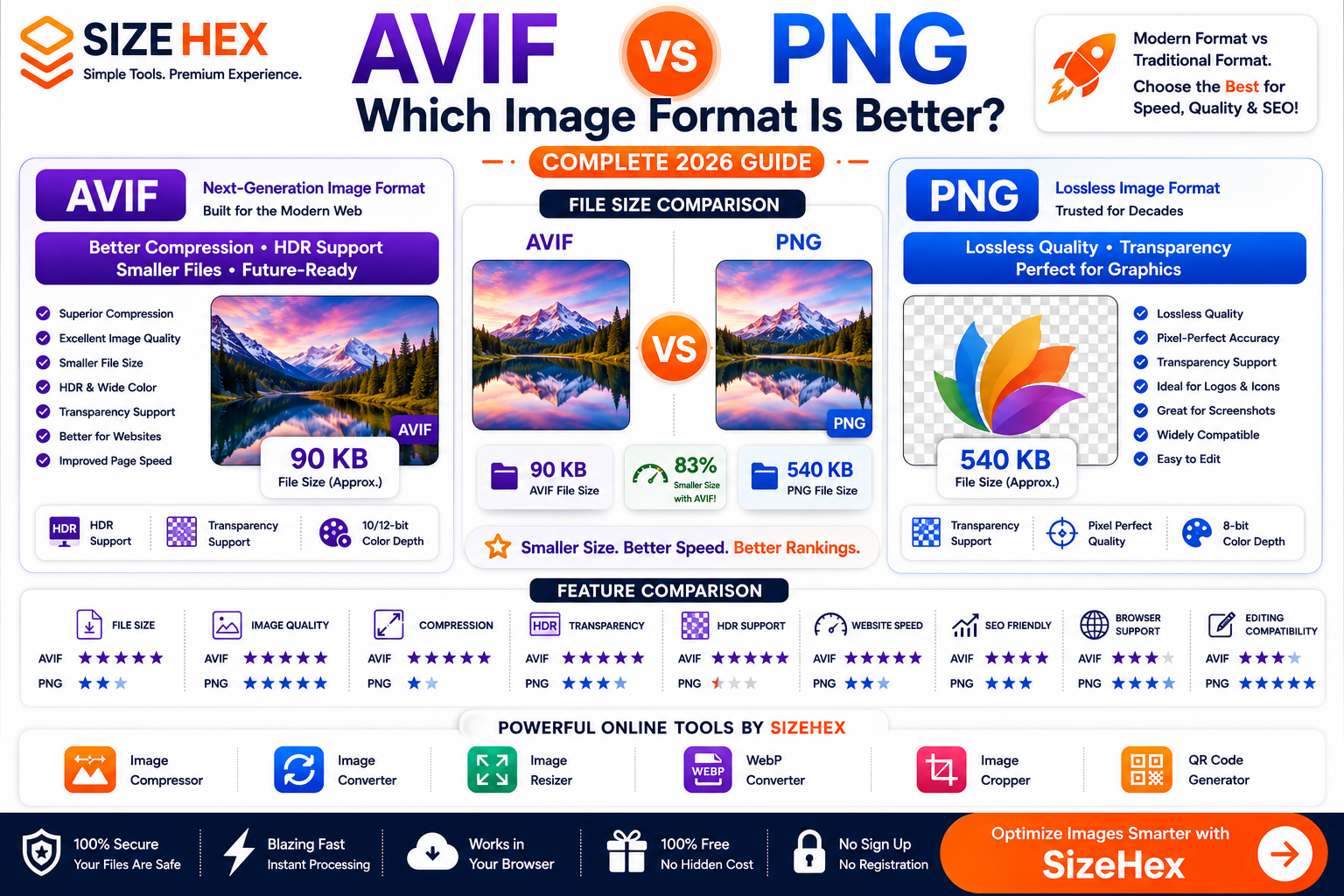
Quick Comparison Table
| Feature | AVIF | PNG |
|---|---|---|
| Image Type | Raster | Raster |
| Compression | Lossy & Lossless | Lossless |
| File Size | ⭐⭐⭐⭐⭐ | ⭐⭐ |
| Image Quality | ⭐⭐⭐⭐⭐ | ⭐⭐⭐⭐⭐ |
| Transparency | ✅ Yes | ✅ Yes |
| HDR Support | ✅ Yes | ❌ No |
| Color Depth | Up to 12-bit | 8-bit |
| Photography | Excellent | Good |
| Graphics | Excellent | Excellent |
| Website Performance | Excellent | Good |
| SEO | Excellent | Good |
| Browser Support | Modern Browsers | Universal |
The biggest difference is that AVIF focuses on maximum compression and performance, while PNG prioritizes lossless quality and universal compatibility.
Image Quality Comparison
Image quality is one of the biggest reasons people choose PNG or AVIF.
Both formats produce excellent-looking images, but they achieve this in different ways.
AVIF
AVIF delivers outstanding visual quality while maintaining extremely small file sizes.
Its advanced compression algorithms preserve:
- Fine textures
- Smooth gradients
- Rich colors
- High dynamic range
- Detailed photographs
AVIF is particularly effective for:
- Product photography
- Landscape photography
- Blog banners
- Website images
- Marketing visuals
PNG
PNG preserves every pixel because it uses lossless compression.
This makes it perfect for:
- Screenshots
- Logos
- Interface graphics
- Images containing text
- Digital artwork
Unlike AVIF, PNG does not lose image information during compression.
However, this comes at the cost of significantly larger file sizes.
Winner
- Photography: 🏆 AVIF
- Screenshots: 🏆 PNG
- Graphics with Text: 🏆 PNG
- Overall Web Quality: 🏆 AVIF
File Size Comparison
File size directly affects website speed and storage requirements.
Here's a typical comparison:
| Image Type | AVIF | PNG |
|---|---|---|
| Product Photo | 90 KB | 540 KB |
| Blog Banner | 150 KB | 780 KB |
| Landscape Image | 180 KB | 950 KB |
| Screenshot | 220 KB | 420 KB |
Actual file sizes depend on image complexity and export settings, but AVIF consistently delivers much smaller files than PNG for most photographic and web images.
Winner
🏆 AVIF
Compression Technology
Compression determines how efficiently an image format reduces file size while preserving image quality.
AVIF Compression
AVIF uses advanced compression technology based on the AV1 codec.
Benefits include:
- Exceptional compression efficiency
- Smaller file sizes
- High-quality visuals
- HDR support
- Better handling of gradients
- Support for both lossy and lossless compression
These features make AVIF one of the most efficient image formats available for modern websites.
PNG Compression
PNG uses lossless compression.
Advantages include:
- No quality loss
- Pixel-perfect accuracy
- Excellent text rendering
- Ideal for graphics requiring transparency
- Consistent quality after repeated saves
The trade-off is larger file sizes compared to AVIF.
Winner
🏆 AVIF
AVIF vs PNG for Websites
Choosing the right image format can have a significant impact on your website's speed, SEO, and overall user experience.
While both AVIF and PNG deliver excellent image quality, they are optimized for different purposes.
AVIF
AVIF is designed for modern websites where performance matters.
It offers excellent image quality while keeping file sizes extremely small.
Ideal website uses include:
- Hero banners
- Blog featured images
- Product photos
- Landing pages
- Portfolio galleries
- Background images
- Marketing visuals
- E-commerce websites
Because AVIF files are much smaller than PNG files, pages load faster and consume less bandwidth.
PNG
PNG remains one of the best choices for graphics that require pixel-perfect quality.
Ideal uses include:
- Company logos
- UI elements
- Website icons
- Screenshots
- Infographics
- Graphics with transparent backgrounds
Although PNG delivers outstanding quality, its larger file sizes can slow down websites if overused.
Winner for Websites
🏆 AVIF
For most modern websites, AVIF provides better performance without noticeably sacrificing image quality.
SEO Comparison
Image optimization is an important part of technical SEO.
Optimized images help improve:
- Page Speed
- Core Web Vitals
- Largest Contentful Paint (LCP)
- Mobile Performance
- User Experience
- Crawl Efficiency
AVIF
AVIF supports SEO by providing:
- Extremely small file sizes
- Faster loading pages
- Reduced bandwidth usage
- Better Lighthouse scores
- Improved Core Web Vitals
Because search engines value fast-loading pages, AVIF can contribute to better technical SEO.
PNG
PNG images are also SEO-friendly when they are:
- Properly compressed
- Correctly resized
- Given descriptive filenames
- Supplied with meaningful alt text
However, their larger file sizes can negatively impact loading speed compared to AVIF.
SEO Best Practices
Regardless of the image format:
- Compress images before uploading.
- Use descriptive filenames.
- Add accurate alt text.
- Serve images at the correct dimensions.
- Enable lazy loading where appropriate.
- Avoid uploading unnecessarily large files.
Winner for SEO
🏆 AVIF
Its superior compression helps websites achieve faster loading times, which can improve technical SEO.
Transparency Support
Transparency is essential for logos, icons, and interface elements.
AVIF
AVIF supports full alpha transparency.
This makes it suitable for:
- Transparent logos
- Product cutouts
- Website graphics
- UI components
- App assets
Unlike older formats such as JPG, AVIF can maintain transparency while still offering excellent compression.
PNG
PNG has long been the industry standard for transparent images.
Advantages include:
- Lossless transparency
- Pixel-perfect edges
- Broad software support
- Reliable rendering across platforms
This is why many designers still use PNG during the design process.
Winner
🏆 Tie
- AVIF offers transparency with much smaller file sizes.
- PNG offers unmatched compatibility and lossless quality.
Photography
Photography is one of the biggest use cases for modern image formats.
AVIF
AVIF excels at displaying photographs.
Ideal for:
- Product photography
- Travel photography
- Food photography
- Landscape photography
- Fashion photography
- Real estate photography
Benefits include:
- Rich colors
- Better compression
- Smaller files
- Smooth gradients
- Excellent detail retention
PNG
PNG can store photographs without quality loss, but the resulting files are often several times larger than AVIF.
For large photo collections, PNG is usually not the most practical option because of storage and bandwidth requirements.
Winner
🏆 AVIF
Graphics & UI Design
Graphics, interface elements, and illustrations require sharp edges and clean text.
AVIF
AVIF works well for many modern graphics while keeping file sizes low.
It is increasingly used for:
- Marketing graphics
- Website banners
- Promotional images
- Social media graphics
PNG
PNG remains one of the best formats for:
- UI mockups
- App screenshots
- Interface graphics
- Buttons
- Icons
- Text-heavy images
Its lossless compression ensures crisp edges and readable text.
Winner
🏆 PNG
For interface graphics and screenshots, PNG still offers the best balance of quality and editing flexibility.
Browser Support
Browser compatibility is an important consideration when choosing an image format.
AVIF
AVIF is supported by all major modern browsers, including:
- Google Chrome
- Microsoft Edge
- Mozilla Firefox
- Opera
- Apple Safari (current versions)
Older browsers or outdated operating systems may not support AVIF, so some websites provide fallback images.
PNG
PNG has universal support.
It works across:
- Every major browser
- All operating systems
- Mobile devices
- Desktop applications
- Design software
- Printers
PNG remains one of the safest choices when broad compatibility is required.
Winner
🏆 PNG
Editing Software Support
Support in image editing applications is another important consideration.
AVIF
Support for AVIF continues to improve.
Many current image editors can now open, edit, and export AVIF images, though some older applications may require updates or plugins.
PNG
PNG is supported by virtually every image editing application, including:
- Adobe Photoshop
- Adobe Illustrator
- Adobe Lightroom
- Affinity Photo
- GIMP
- Canva
- Figma
- Paint.NET
- Microsoft Paint
- Preview (macOS)
Winner
🏆 PNG
Pros & Cons
AVIF
Pros
- Outstanding compression
- Excellent image quality
- Much smaller file sizes
- Transparency support
- HDR support
- Wide color gamut
- Faster website loading
- Better Core Web Vitals
Cons
- Limited support in some older software
- Slower encoding than PNG in some workflows
- Legacy browsers may require fallback images
PNG
Pros
- Lossless quality
- Excellent transparency support
- Perfect for screenshots
- Great for logos and UI graphics
- Universal compatibility
- Easy to edit
- Broad software support
Cons
- Large file sizes
- Higher bandwidth usage
- Slower page loading compared to AVIF
- Less efficient compression
Best Practices
For the best balance of quality and performance:
- Use AVIF for blog images, hero banners, product photos, and website backgrounds.
- Use PNG for logos, screenshots, UI elements, and graphics that require pixel-perfect accuracy.
- Keep original design files for future editing.
- Resize images before uploading them.
- Add descriptive filenames and alt text to improve SEO.
- Consider serving AVIF images with PNG fallbacks if you need to support older browsers or legacy systems.
AVIF vs PNG: Which One Should You Choose?
Both AVIF and PNG are excellent image formats, but they are designed for different purposes. While PNG has been a trusted standard for decades, AVIF brings modern compression technology that significantly reduces file sizes while maintaining outstanding image quality.
Instead of choosing one format for everything, it's best to use each where it performs best.
Choose AVIF if you need:
- Website hero banners
- Blog featured images
- Product photos
- E-commerce websites
- Portfolio galleries
- Marketing graphics
- Faster page loading
- Better Core Web Vitals
- Reduced bandwidth usage
AVIF is the ideal choice when website speed and image optimization are your top priorities.
Choose PNG if you need:
- Company logos
- App icons
- Website UI elements
- Screenshots
- Graphics with text
- Transparent illustrations
- Design mockups
- Images requiring lossless quality
PNG remains the preferred format for graphics that demand pixel-perfect accuracy and broad compatibility.
Final Comparison Table
Category AVIF PNG Image Type Raster Raster Compression ⭐⭐⭐⭐⭐ ⭐⭐⭐ File Size ⭐⭐⭐⭐⭐ ⭐⭐ Image Quality ⭐⭐⭐⭐⭐ ⭐⭐⭐⭐⭐ Transparency ✅ ✅ HDR Support ✅ ❌ Color Depth Up to 12-bit 8-bit Photography ⭐⭐⭐⭐⭐ ⭐⭐⭐⭐ Graphics & UI ⭐⭐⭐⭐ ⭐⭐⭐⭐⭐ Website Performance ⭐⭐⭐⭐⭐ ⭐⭐⭐ SEO ⭐⭐⭐⭐⭐ ⭐⭐⭐⭐ Browser Support ⭐⭐⭐⭐ ⭐⭐⭐⭐⭐ Editing Software ⭐⭐⭐⭐ ⭐⭐⭐⭐⭐ Overall Winners
🏆 Best for Websites: AVIF
🏆 Best for Page Speed: AVIF
🏆 Best for SEO: AVIF
🏆 Best for Product Images: AVIF
🏆 Best for Photography: AVIF
🏆 Best for Logos & UI Graphics: PNG
🏆 Best for Screenshots: PNG
🏆 Best for Universal Compatibility: PNG
Frequently Asked Questions (FAQ)
Is AVIF better than PNG?
It depends on the use case.
For websites, AVIF is generally the better option because it delivers much smaller file sizes while maintaining excellent image quality.
For screenshots, logos, and graphics that require lossless quality, PNG is often the better choice.
Can AVIF replace PNG?
In many situations, yes.
AVIF supports transparency and excellent image quality, making it suitable for many web graphics.
However, PNG remains valuable for editing workflows, screenshots, and applications where universal compatibility or lossless quality is essential.
Which format has a smaller file size?
AVIF typically produces significantly smaller files than PNG while maintaining comparable visual quality, especially for photographs and web graphics.
Is AVIF good for SEO?
Yes.
Smaller image files contribute to faster page loading, improved Core Web Vitals, and better user experience, all of which support technical SEO.
Image SEO also depends on using descriptive filenames, meaningful alt text, and serving images at appropriate dimensions.
Do both AVIF and PNG support transparency?
Yes.
Both formats support transparent backgrounds.
The main difference is that AVIF usually achieves much smaller file sizes, while PNG focuses on preserving every pixel without quality loss.
Which format is better for logos?
If your logo is available as a vector graphic, SVG is usually the best option because it scales infinitely without losing quality.
Between AVIF and PNG, PNG is generally preferred for raster logos because it preserves sharp edges and is supported by virtually every browser, editor, and platform.
Which format should I use for website images?
For photographs, banners, and marketing visuals, AVIF is usually the better choice because it combines excellent image quality with smaller file sizes.
For screenshots, interface graphics, and transparent raster assets, PNG remains a strong choice.
Should I convert my PNG images to AVIF?
If your goal is to improve website performance and reduce file sizes, converting suitable PNG images to AVIF can be beneficial.
Before replacing all PNG files, ensure that your website, CMS, image pipeline, and target audience's browsers support AVIF adequately, or provide PNG fallbacks where necessary.
Conclusion
Both AVIF and PNG are excellent image formats, but they excel in different scenarios.
- AVIF is the modern choice for photographs, product images, hero banners, and other web visuals where reducing file size without sacrificing quality is important.
- PNG remains one of the best formats for screenshots, interface graphics, logos, and transparent raster images because it preserves every pixel and offers near-universal compatibility.
For most modern websites, a combination of both formats works best:
- Use AVIF for photos and large visual content.
- Use PNG for screenshots, UI graphics, and transparent raster artwork.
- Consider SVG for logos and icons whenever possible.
Choosing the right format for each type of image helps improve website performance, enhance user experience, and support better search engine optimization.
Try SizeHex Today
Optimize your images with SizeHex—a fast, secure, and free online image toolkit.
Whether you need to compress, resize, convert, crop, or generate QR codes, SizeHex helps you prepare images for websites, blogs, e-commerce stores, and social media directly in your browser.
Related Tools
Image Compressor
Compress AVIF, PNG, JPG, WebP, GIF, BMP, TIFF, and more without noticeable quality loss.
Image Converter
https://www.sizehex.com/image-converter.html
Convert images between AVIF, PNG, JPG, WebP, SVG, BMP, GIF, TIFF, and other popular formats.
Image Resizer
https://www.sizehex.com/image-resizer.html
Resize images for websites, blogs, online stores, social media, and presentations.
Image Cropper
https://www.sizehex.com/image-crop.html
Crop images online using custom dimensions or preset aspect ratios in seconds.
WebP Converter
https://www.sizehex.com/webp-converter.html
Convert JPG and PNG images into WebP to improve website speed and reduce file size.
QR Code Generator
Generate QR codes for URLs, Wi-Fi credentials, contact information, phone numbers, emails, and more.