July 28, 2026
PNG vs SVG: Which Image Format Should You Use? (Complete 2026 Guide)
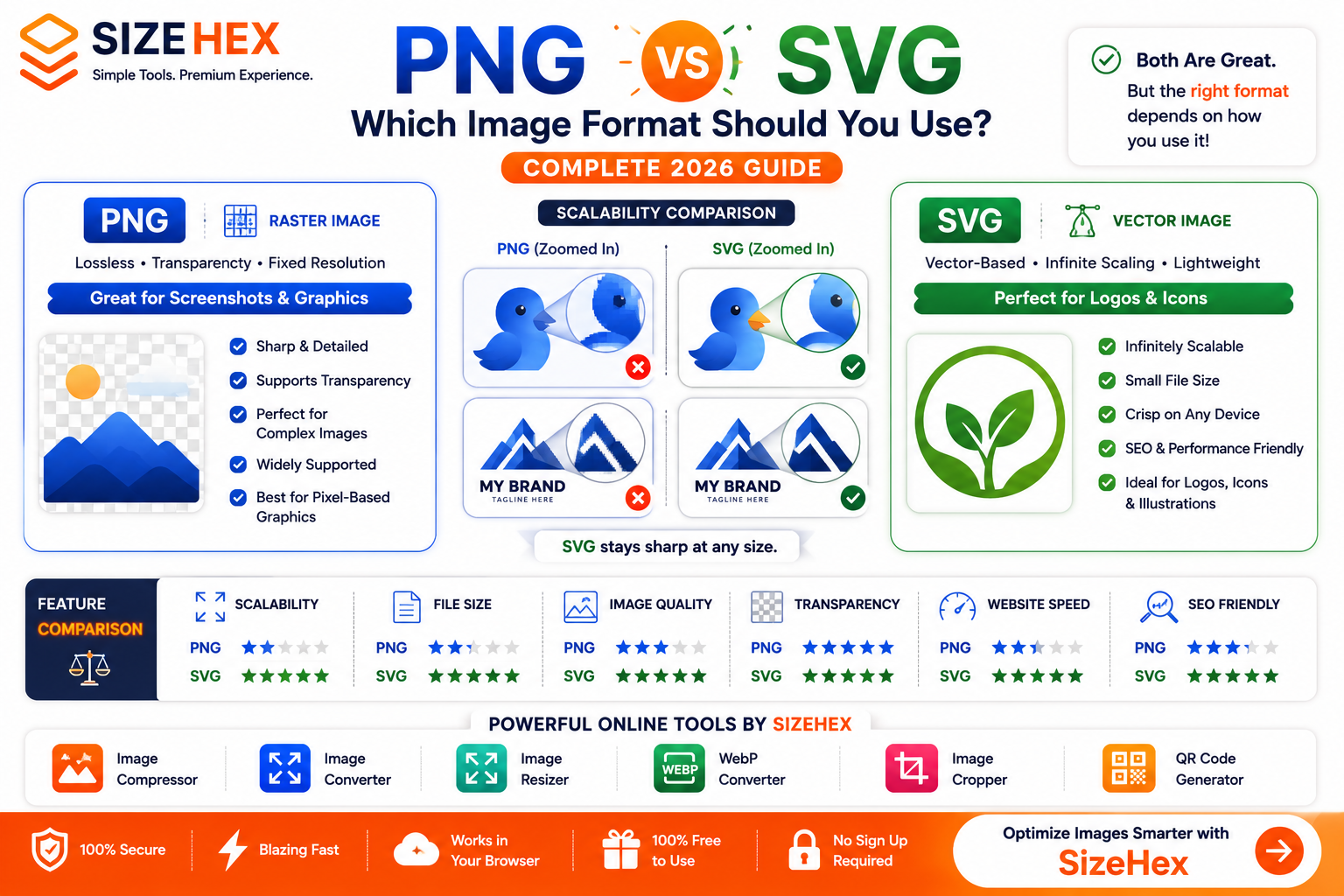
PNG vs SVG: Which Image Format Should You Use?
Choosing the right image format is essential for creating fast, visually appealing, and SEO-friendly websites. Whether you're designing a logo, building a website, creating user interface elements, or publishing blog graphics, the image format you choose directly affects quality, scalability, loading speed, and user experience.
Among the most popular formats for web graphics are PNG and SVG. While both are widely used, they are built for completely different purposes.
- PNG is a raster image format that stores images as pixels. It is perfect for screenshots, graphics, and images that require transparency.
- SVG is a vector image format that uses mathematical paths instead of pixels. It can be scaled to any size without losing quality, making it ideal for logos, icons, and illustrations.
Many beginners struggle to decide which format is better because both support transparency and are commonly used on websites.
So, which one should you choose?
The answer depends on how the image will be used.
In this complete guide, we'll compare PNG vs SVG based on image quality, scalability, file size, transparency, SEO, website performance, browser compatibility, and the best use cases for each format.
What Is PNG?
PNG (Portable Network Graphics) is a lossless raster image format introduced in 1996 as an alternative to GIF.
Unlike JPG, PNG preserves all image details during compression, making it ideal for graphics where quality is important.
Since PNG stores images as pixels, every image has a fixed resolution. Enlarging a PNG beyond its original size causes the image to become blurry or pixelated.
Key Features of PNG
- Lossless compression
- Supports transparent backgrounds
- Excellent image quality
- Sharp text and graphics
- Widely supported
- Great for screenshots
- Ideal for UI elements
- Suitable for digital graphics
PNG is commonly used for:
- Logos
- Website graphics
- Infographics
- App screenshots
- Icons
- Product images with transparency
Although PNG provides excellent quality, the files are usually much larger than modern alternatives like WebP or SVG.
What Is SVG?
SVG (Scalable Vector Graphics) is a vector-based image format created specifically for scalable graphics.
Unlike PNG, SVG does not store images as pixels.
Instead, it stores mathematical instructions that describe shapes, lines, curves, colors, and text.
Because of this, SVG images can be resized infinitely without losing quality.
Whether displayed at 32×32 pixels or 4K resolution, an SVG remains perfectly sharp.
Key Features of SVG
- Vector-based graphics
- Infinite scalability
- Extremely small file sizes
- Perfect for logos
- Great for icons
- Search-engine friendly
- Editable using code
- Supports animation
- Responsive by nature
SVG is commonly used for:
- Company logos
- Website icons
- UI illustrations
- Infographics
- Charts
- Diagrams
- Brand graphics
SVG has become one of the preferred formats for modern websites because it combines sharp visuals with excellent performance.
Raster vs Vector Images
Understanding the difference between raster and vector graphics is the key to choosing the right image format.
Raster Images (PNG)
Raster images are made up of thousands or even millions of tiny colored squares called pixels.
Every image has a fixed resolution.
For example:
- 500 × 500 pixels
- 1000 × 1000 pixels
- 2000 × 2000 pixels
If you enlarge a raster image beyond its original resolution, those pixels become visible, making the image appear blurry or pixelated.
Raster images are best suited for:
- Photographs
- Screenshots
- Complex digital artwork
- Detailed graphics
Vector Images (SVG)
Vector images are built using mathematical paths rather than pixels.
Instead of storing every pixel, SVG files store information about:
- Lines
- Curves
- Shapes
- Colors
- Coordinates
Because of this, vector graphics can scale to any size without losing quality.
Whether displayed on a smartwatch or a large billboard, an SVG remains perfectly crisp.
Vector images are ideal for:
- Logos
- Icons
- Brand graphics
- Charts
- UI elements
- Illustrations
Quick Comparison Table
| Feature | PNG | SVG |
|---|---|---|
| Image Type | Raster | Vector |
| Compression | Lossless | Vector-Based |
| Scalability | Fixed Resolution | ✅ Infinite |
| Transparency | ✅ Yes | ✅ Yes |
| File Size | Medium to Large | Usually Small |
| Photography | ✅ Excellent | ❌ Not Suitable |
| Logos | Good | ✅ Best |
| Icons | Good | ✅ Best |
| Illustrations | Good | ✅ Best |
| Website Performance | Good | ✅ Excellent |
| SEO | Good | ✅ Excellent |
| Browser Support | Excellent | Excellent |
The biggest difference is that PNG is pixel-based, while SVG is vector-based.
Image Quality Comparison
Image quality depends on how the image is displayed.
PNG
PNG delivers excellent quality because it uses lossless compression.
It preserves every pixel, making it ideal for:
- Screenshots
- Graphics
- User interface elements
- Images with text
However, if a PNG is enlarged beyond its original resolution, it loses sharpness and becomes pixelated.
SVG
SVG maintains perfect quality at every size because it is vector-based.
You can enlarge an SVG from a tiny website icon to a large billboard without any loss of detail.
This makes SVG the preferred choice for:
- Company logos
- Icons
- Brand assets
- Line illustrations
- UI graphics
However, SVG is not suitable for photographs because vector graphics cannot accurately represent the millions of color variations found in photo-realistic images.
Winner
- Logos & Icons: ✅ SVG
- Screenshots & Detailed Graphics: ✅ PNG
- Photography: ✅ PNG
File Size Comparison
Smaller image files help websites load faster and improve user experience.
Here's a typical comparison:
| Image Type | PNG | SVG |
|---|---|---|
| Simple Logo | 450 KB | 18 KB |
| Simple Icon | 120 KB | 6 KB |
| Line Illustration | 900 KB | 40 KB |
For simple graphics, SVG files are often dramatically smaller than PNG files because they store mathematical instructions instead of individual pixels.
However, SVG is not efficient for photographs or highly detailed images, where PNG or modern raster formats are more appropriate.
Winner
🏆 SVG
Understanding Scalability
Scalability is one of the biggest differences between PNG and SVG.
PNG Scalability
PNG images have a fixed number of pixels.
If you enlarge a 500 × 500 PNG to 2000 × 2000, the image stretches and becomes blurry because no new detail is created.
SVG Scalability
SVG graphics scale infinitely.
Whether the image is displayed as:
- A 16 × 16 website icon
- A mobile app logo
- A desktop banner
- A billboard
The image remains perfectly sharp because it is redrawn mathematically at every size.
This makes SVG the preferred format for responsive web design and modern branding.
Winner: 🏆 SVG
PNG vs SVG for Websites
Choosing the right image format for your website directly affects page speed, user experience, SEO, and overall performance.
Both PNG and SVG are widely supported by modern browsers, but they serve different purposes.
PNG
PNG is ideal for images that contain many colors, gradients, or pixel-based details.
Best website uses include:
- Screenshots
- Product images with transparency
- Infographics
- UI mockups
- Blog graphics
Although PNG delivers excellent quality, its larger file sizes can slow down websites if not optimized.
SVG
SVG was designed specifically for the web.
Because SVG files contain mathematical instructions instead of pixels, they are usually much smaller and scale perfectly on every screen.
SVG is perfect for:
- Company logos
- Navigation icons
- UI components
- Buttons
- Brand graphics
- Charts
- Simple illustrations
SVG also looks incredibly sharp on high-resolution (Retina) displays.
Winner for Websites
🥇 SVG
SEO Comparison
Google does not rank websites based on image format alone.
However, image optimization contributes to:
- Faster page speed
- Better Core Web Vitals
- Improved user experience
- Lower bounce rates
PNG
PNG images are SEO-friendly when:
- Properly compressed
- Named correctly
- Provided with descriptive alt text
However, their larger file sizes can negatively affect loading speed if overused.
SVG
SVG files are generally much smaller than PNG files for logos and icons.
Benefits include:
- Faster loading
- Better Lighthouse scores
- Improved Core Web Vitals
- Smaller page size
- Responsive graphics
Because SVG is XML-based, developers can also optimize and manipulate it using CSS and JavaScript, making it especially useful for modern web interfaces.
SEO Best Practices
- Compress raster images.
- Use SVG for logos and icons.
- Write descriptive alt text.
- Use meaningful filenames.
- Resize raster images before uploading.
- Avoid oversized PNG files.
Winner for SEO
🥇 SVG
Best Format for Logos & Branding
Logos need to remain sharp across every device and screen size.
PNG
PNG provides excellent quality but has fixed dimensions.
If a PNG logo is enlarged beyond its original resolution, it becomes blurry.
SVG
SVG logos scale infinitely.
Whether displayed:
- On a favicon
- Mobile app
- Business card
- Website header
- Billboard
The logo remains perfectly crisp.
This is why most professional brands provide their official logos in SVG format.
Winner
🥇 SVG
Best Format for Icons
Icons appear everywhere on websites:
- Navigation bars
- Buttons
- Apps
- Dashboards
- Menus
SVG is the industry standard because:
- It scales perfectly.
- It loads quickly.
- It stays sharp on Retina displays.
- Colors can be changed with CSS.
- It can be animated.
PNG icons still work well but require multiple resolutions (1x, 2x, 3x) to remain sharp on different screens.
Winner
🥇 SVG
Best Format for UI/UX Design
Modern interfaces require scalable graphics that adapt to many screen sizes.
PNG
PNG is useful for:
- UI mockups
- Design previews
- Static interface screenshots
SVG
SVG is ideal for production UI because it supports:
- Responsive scaling
- CSS styling
- JavaScript interaction
- Lightweight assets
- Dark mode customization
- Smooth animations
Most modern design systems use SVG for icons and interface graphics.
Winner
🥇 SVG
Best Format for Photography
Photography contains millions of colors, fine textures, and complex gradients.
PNG
PNG preserves photographic quality without compression loss, but it produces large files.
For websites, formats like JPG, WebP, or AVIF are usually more practical for photos because they offer much smaller file sizes.
SVG
SVG is not designed for photographs.
Since SVG uses mathematical paths, it cannot efficiently represent photo-realistic images.
Attempting to recreate a photograph as SVG would result in an extremely large and impractical file.
Winner
🥇 PNG
Best Format for Illustrations
Illustrations can be either raster or vector.
PNG
PNG works well for:
- Digital paintings
- Detailed artwork
- Texture-rich illustrations
SVG
SVG excels at:
- Flat illustrations
- Infographics
- Charts
- Icons
- Brand artwork
- Character illustrations with simple shapes
Because SVG scales infinitely, it's the preferred format for web illustrations.
Winner
🥇 SVG
Pros & Cons
PNG
Pros
- Lossless image quality
- Transparency support
- Excellent for screenshots
- Great for graphics
- Widely supported
- Easy to edit
Cons
- Large file sizes
- Pixelates when enlarged
- Not scalable
- Slower loading compared to SVG for simple graphics
SVG
Pros
- Infinite scalability
- Extremely small file sizes for vector graphics
- Perfect for logos and icons
- Excellent website performance
- CSS customizable
- JavaScript support
- Animation support
- Retina display friendly
Cons
- Not suitable for photographs
- Less effective for highly detailed raster artwork
- Requires vector-based artwork to take full advantage of the format
Best Practices
For the best website performance and visual quality:
- Use SVG for logos, icons, buttons, simple illustrations, and interface elements.
- Use PNG for screenshots, complex graphics, and images that need lossless raster quality.
- For photographs, prefer JPG, WebP, or AVIF instead of PNG or SVG.
- Compress PNG files before uploading them to your website.
- Optimize SVG files by removing unnecessary metadata.
- Add descriptive filenames and alt text to improve image SEO.
- Test your images on desktop, tablet, and mobile devices to ensure they remain clear and load quickly.
PNG vs SVG: Which One Should You Choose?
Both PNG and SVG are excellent image formats, but they are designed for different purposes. Choosing the right format depends on the type of image you're creating and where it will be used.
Here's a simple guide to help you decide.
Choose PNG if you need:
- Screenshots
- Product images
- Graphics with many colors
- Detailed digital artwork
- Transparent backgrounds
- High-quality raster images
- UI mockups
- Images that contain complex textures
PNG is the best choice when preserving every pixel is more important than keeping the file size as small as possible.
Choose SVG if you need:
- Company logos
- Website icons
- App icons
- UI elements
- Brand illustrations
- Infographics
- Charts
- Responsive graphics
- Animated web graphics
SVG is the ideal choice for graphics that need to remain perfectly sharp at any size.
Final Comparison Table
Category PNG SVG Image Type Raster Vector Scalability ⭐⭐ ⭐⭐⭐⭐⭐ File Size ⭐⭐⭐ ⭐⭐⭐⭐⭐ Transparency ✅ ✅ Photography ⭐⭐⭐⭐⭐ ⭐ Logos ⭐⭐⭐ ⭐⭐⭐⭐⭐ Icons ⭐⭐⭐ ⭐⭐⭐⭐⭐ Illustrations ⭐⭐⭐⭐ ⭐⭐⭐⭐⭐ Website Performance ⭐⭐⭐ ⭐⭐⭐⭐⭐ SEO ⭐⭐⭐⭐ ⭐⭐⭐⭐⭐ Browser Support ⭐⭐⭐⭐⭐ ⭐⭐⭐⭐⭐ Responsive Design ⭐⭐ ⭐⭐⭐⭐⭐ Overall Winners
🥇 Best for Logos: SVG
🥇 Best for Icons: SVG
🥇 Best for Website Performance: SVG
🥇 Best for Photography: PNG
🥇 Best for Screenshots: PNG
Frequently Asked Questions (FAQ)
Is SVG better than PNG?
It depends on the use case.
SVG is better for logos, icons, and illustrations because it scales infinitely without losing quality.
PNG is better for screenshots, complex graphics, and images made up of pixels.
Can SVG replace PNG?
Not always.
SVG works well for vector graphics but is not suitable for photographs or highly detailed raster artwork.
Many websites use both formats together.
Which format is smaller?
For logos, icons, and simple graphics, SVG files are usually much smaller than PNG files.
However, SVG is not designed for photographs, where PNG or other raster formats are more appropriate.
Which format is better for SEO?
SVG often provides better website performance because of its smaller file size and infinite scalability.
However, SEO also depends on image optimization, descriptive filenames, alt text, and page speed.
Does SVG support transparency?
Yes.
SVG fully supports transparent backgrounds, making it ideal for logos, icons, and branding assets.
Can SVG be animated?
Yes.
SVG supports CSS and JavaScript animations, making it a popular choice for interactive web elements, icons, and illustrations.
PNG does not support native animation.
Can I convert PNG to SVG?
You can convert simple graphics and logos from PNG to SVG using vectorization tools.
However, converting photographs or detailed raster artwork usually does not produce clean or editable SVG files because SVG is designed for vector graphics.
Which format is better for logos?
SVG is the industry standard for logos because it remains perfectly sharp at any size and generally results in smaller file sizes than PNG for vector artwork.
Conclusion
Both PNG and SVG play important roles in modern web design, but they solve different problems.
- PNG is best for screenshots, transparent raster graphics, detailed artwork, and images that rely on pixel-perfect quality.
- SVG is the preferred choice for logos, icons, illustrations, and scalable web graphics because it offers infinite scalability, smaller file sizes for vector artwork, and excellent performance.
Using the right format for the right purpose helps improve website speed, maintain visual quality, and create a better user experience.
For the best results, many websites use SVG for vector graphics and PNG for raster images, allowing each format to play to its strengths.
Try SizeHex Today
Optimize your images with SizeHex—a fast, secure, and free online image toolkit.
Whether you need to compress, resize, convert, crop, or generate QR codes, SizeHex helps you prepare images for websites, blogs, e-commerce stores, and social media directly in your browser.
Related Tools
Image Compressor
Compress PNG, JPG, WebP, AVIF, and other image formats without noticeable quality loss.
Image Converter
https://www.sizehex.com/image-converter.html
Convert images between PNG, SVG, JPG, WebP, AVIF, BMP, GIF, TIFF, and more.
Image Resizer
https://www.sizehex.com/image-resizer.html
Resize images for websites, blogs, social media, presentations, and e-commerce stores.
WebP Converter
https://www.sizehex.com/webp-converter.html
Convert PNG and JPG images to WebP for improved website performance.
Image Cropper
https://www.sizehex.com/image-crop.html
Crop images online with custom dimensions or preset aspect ratios in seconds.
QR Code Generator
https://www.sizehex.com/qr-generator.html
Generate QR codes for URLs, Wi-Fi networks, contact details, emails, phone numbers, and more.